
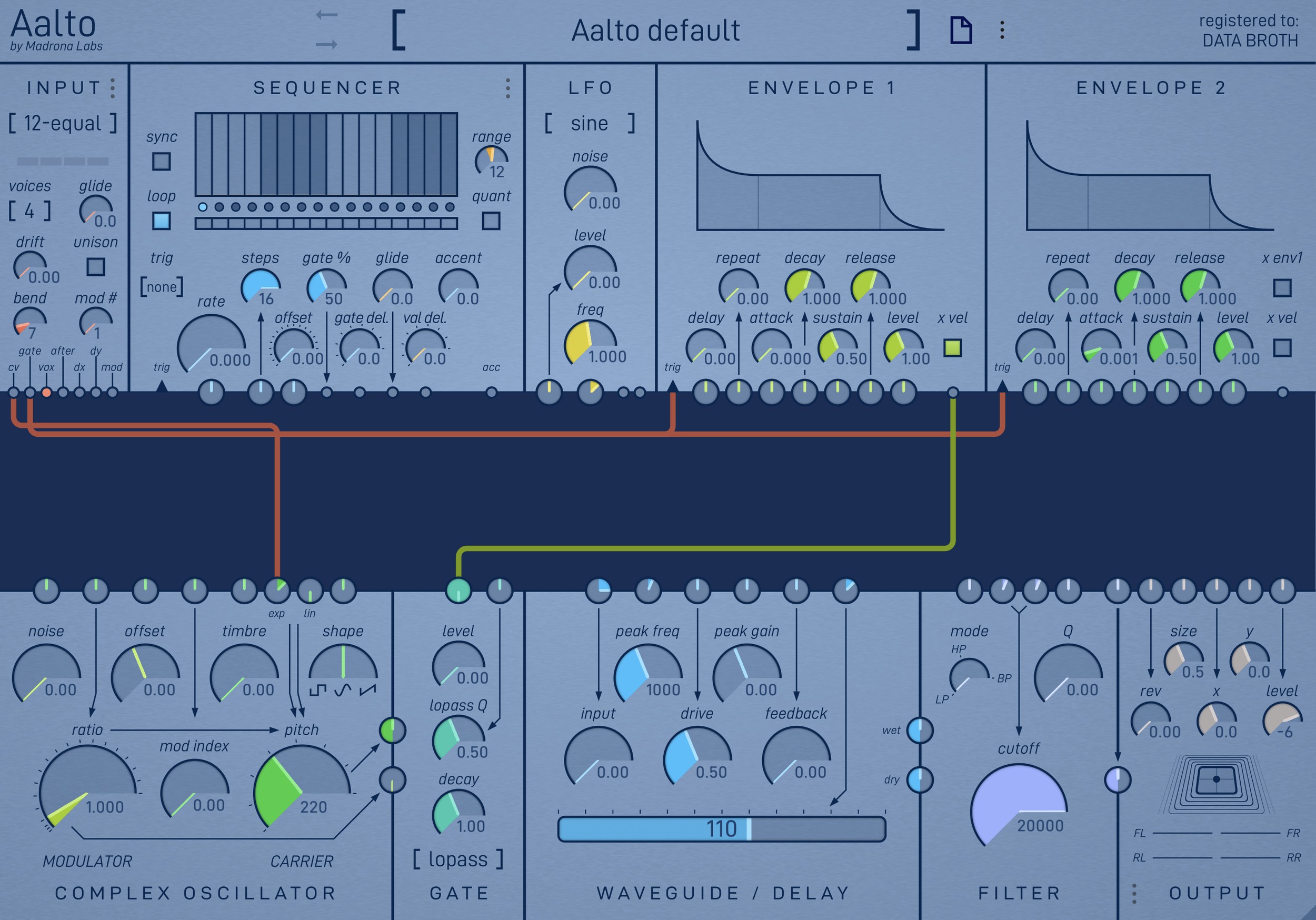
Madrona Labs have just updated their classic synth Aalto to version 2. Aalto is a west-coast style semi-modular synthesizer with waveguide delay and a built in sequencer. Version 2 expands the original modular synthesis engine by adding an LFO to each control, allowing you to modulate just about everything.
Aalto’s UI is nice and flat with a subtle papery texture in the background. I really dig the mod matrix. It has a simple visual style that clearly shows signal path with color coordination to help distinguish each source.
The core synthesis is accomplished via a “complex” FM style oscillator that has controls for shape, timbre, noise, and modulation ratio/index. This gets you a variety of rich tones with lots of metallic grit. This oscillator is fed into a west-cost style lowpass gate. which has never been my favorite type of filter, but does create very organic sounding percussive motion.
From what I can tell, the waveguide delay does not seem to be polyphonic. Perhaps I was using it wrong, but this limits its utility quite a bit. Having it before the filter also means you end up filtering your delayed signal. I found the waveguide tricky to dial in. Leading to either simple raspy delays, or over the top feedback. From the design, I can tell there is an intended way to use this waveguide delay, but I either couldn’t follow this workflow, or the intended sounds weren’t for me.
The envelopes are solid, providing lots of room to dial in a snappy attack. I really like the repeat function, which pushes each repetition closer together as you add more, allowing you to create fun zippering tones and ratchets. The LFO module now feels redundant with per control LFOs, but it does allow you to add modulation to LFO rate and depth, which the per-control LFOs do not allow for.
As for the per-control LFO, I really like the UI, you right click to access it. However, there are other options, so the LFO requires an extra click every time you need to access it. I’d have loved for the LFO to just be the default right click display, then use the back arrow to access the other options. Or whichever option was accessed last becomes the default for each control. It is a tiny detail, but if I’m not using locks or midi learn at all, it is just added tedium.
On the other hand, when you are in any of the right click menus, the left and right arrows will jump you to the neighboring controls without changing pages. This includes a pleasing animation as it hops between controls. There’s also a subtle motion to the menu which never felt like it got in my way.
As for the LFOs themselves, I just wish there was a sample hold option, as I love controls that jump between random values. There is a smooth noise which is nice though. The rate can also go nice and fast, just into the audio range. I should also mention, many destinations that have quantized values, such as gate delay, sequencer rate, and osc ratio do not quantize when modulated. While LFOs per controls open up a lot of possibilities, I personally would love more “stepped” motion available in general.
Speaking of steps, the sequencer is pretty fun. You can now modulate the value per step, but unfortunately not the step gate its self. Applying an LFO to the total steps count is very fun and starts to get into generative territories. I also really enjoy the gate and value delay, which give their respective signals, but offset by however many steps you select.
Over all, this update is solid, prior to this Aalto was just a bit too simple for me to cover. The LFOs per control really opened up enough motion and sound design potential to get my creative flow going. While there are places I’d like things to be different, I think this is a classic synth and I hope to see some of these changes come to Kaivo.
You can pick up Aalto from Madrona Labs website here: https://madronalabs.com/products/aalto