CYBERDRIVE Review
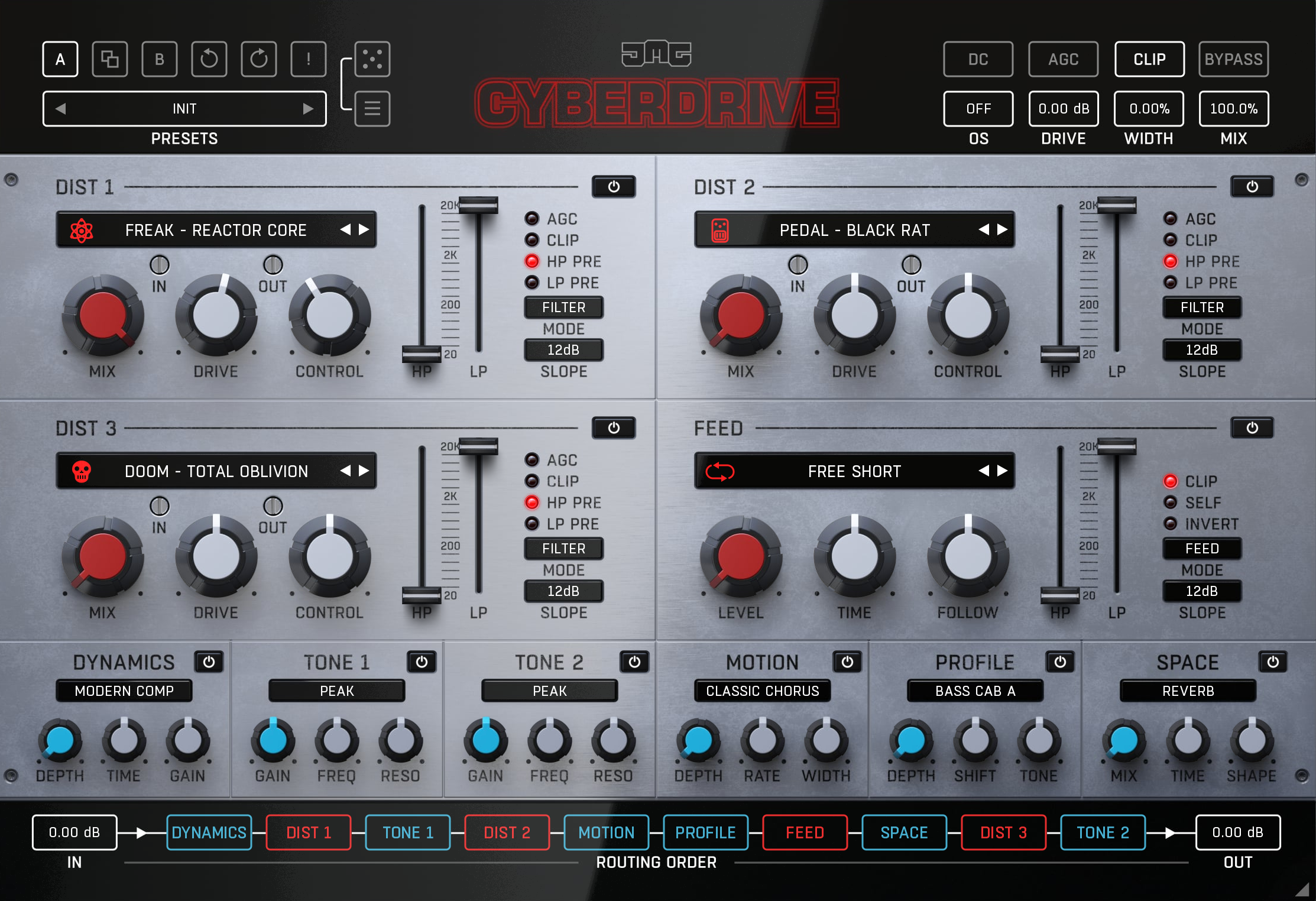
As a fan of multi-distortion plugins, I wanted to take a look at JMG’s Cyberdrive, a three part multi-distortion effect with some added tone shaping. Cyberdrive offers three distortion stages that run in series with some simple dynamics, tone, and profile modules that can be placed anywhere in the signal chain. The lack of multiband splitting and modulation put this into a less flexible category than some more powerful multi-distortion effects, but it is still rather capable.
I actually tend to prefer distortions to not have modulation at this point. Modulation is fun, but it tends to push the effect into more of a motion/glitch territory than mixing/distortion. Extra modulation also means more UI elements and more presets that don’t necessarily produce desirable results. Obviously, “no modulation” isn’t really a selling point, but I just bring this up as modulation is a popular “requirement” for many people when it comes to distortion nowadays.
Each distortion stage has options for mix, drive, an additional control, and some simple filtering. Some degree of parallel routing would be really nice, but simply applying low amounts of drive and mix with three stages can actually build up some intricate distortion tones. I really apreciate the secondary control for each distortion mode, a bit of information for this control would be nice, but it gives each distortion a second layer of dimensionality.
Cyberdrive offers a whopping 64 different distortion modes, rivaling most other multi-distortion plugins in sheer distortion type quantity. These modes are grouped into eight distortion categories: classic, modern, shape, pixel, amp, pedal, doom, freak. There’s a nice balance between extreme modern distortions and more subtle classic distortions, while “classic is only one category, the amps and pedals help fill out the more traditional distortion flavors while modern doom and freak cover extreme destruction very well.
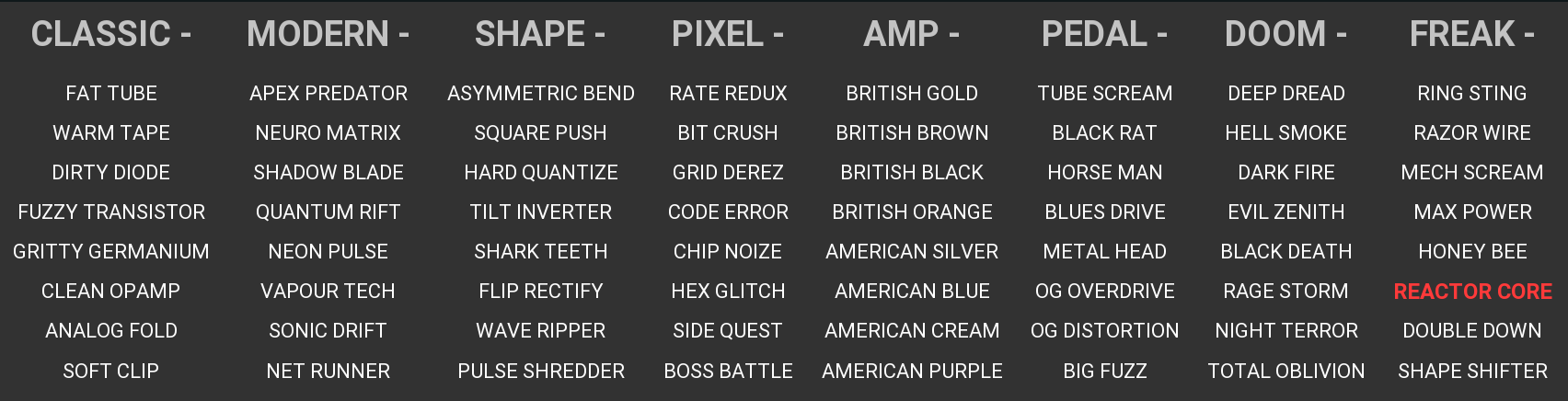
Classic focusses on more traditional distortions, tubes, diodes, transistors, tape. It does have a cool analog folder mode that goes into more extreme territory.
Modern as the name suggests is full of more modern distortions. These have a nice clear grit and are great for adding bright top end texture.
Shape contains a collection of wave-shaper curves. I’m sure people would be happy with custom curves, but this collection covers a lot of cool ground.
Pixel has all of the bit crushing and sample rate reduction type effects. Some of these lean ito glitchy territory.
Amp is for all the amp sims. I think these have cbs baked in as well
Pedal emulates various classic guitar pedals. I really apreciate having these in this type of distortion rather than using a pedal board style plugin.
Doom covers some very dark distortions, there’s a lot of grit to these, but they are heavy and focussed. I found they actually really shine being placed after a more subtle distortion
Freak is where all the most extreme distortions are placed, some of these leave the signal completely unrecognizable. I particularly enjoyed the honey bee, and reactor core algorithms.
A feedback stage really brings this plugin to another level, allowing you to get gritty resonances that cut through the distortion creating screaming overtones. This feedback loop can be placed at any point in the signal chain, making it one of the more flexible feedback systems in regards to alternative multi-distortion effects. The feedback also includes its own filtering, an envelope follower, clipping and inversion. I really apreciate this added layer of depth alongside the abundance of distortion modes
Finally, there’s a few tone modules at the bottom, these are much simpler and more restricted than the distortion types. It’s nice that you can place them anywhere in the signal chain. The profile models offer a good amount of broad tonal characters, though it’s worth mentioning that you can’t load your own IRs if you’re wondering. I personally would have left out the motion and space modules, but they’re there if they are important to you.
I am admittedly a bit pleasantly surprised by Cyberdrive, the UI is a bit “unassuming” and as I said, the lack of modulation and multi-band or any specific distortion gimmick gives this one more straight forward purposes. But the sheer variety means I’ll be playing around with Cyberdrive as an option when all I’m looking for is different distortion characteristics. I would love a parallel lane and the UI isn’t really my favorite, it looks fine, but I’d rather double click to reset a control instead of bringing up the value input. I’m pretty sure JMG has some relation to Melda though as they both share this control scheme.
Complaints aside, this is a very solid distortion plugin, though I’m not fond of their “ You may throw all your distortions in the TRASH” marketting. There’s plenty of reasons to use other distortion, especially if you already own them, I do my best to avoid saying any plugin is “better or worse” than others as they usually all provide something unique. It’s just a matter of finding which option is the right one for you’re personal needs. Though, to be charitable to them, they were likely just poking fun at Trash (3)
If you plan on purchasing CYBERDRIVE from Plugin Boutique, please consider supporting me by using one of my affiliate links.
CYBERDRIVE: https://www.pluginboutique.com/product/2-Effects/30-Distortion/12928-Cyberdrive?a_aid=61c378ab215d5