PURE SUB vs RUMBLE
I found it interesting that Arturia came out with a bass focused synth so soon after UVI came out with their own so I decided to do a side by side shootout to compare how similar or different they are from one another. First off, in no way am I implying that Arturia copied UVI, development for Pure Sub likely began well before Rumble was released. If I had to guess, maybe some sort of market research led both companies to work on similar products, or just purely coincidental. Either way, I think it’s worth looking at Pure Sub and Rumble side by side.
Both are bass focused synths with interfaces that lean towards the more minimal end of things. I enjoy that they both have a similar dark grey vibe, even sharing some purple and green highlights. Both offer drag and drop modulation, undo/redo, and dedicated bass focused workflow.
You can read the full reviews for each synth here:
PURE SUB: https://www.databroth.com/blog/pure-sub-review
RUMBLE: https://www.databroth.com/blog/rumble-review
OSCILLATORS
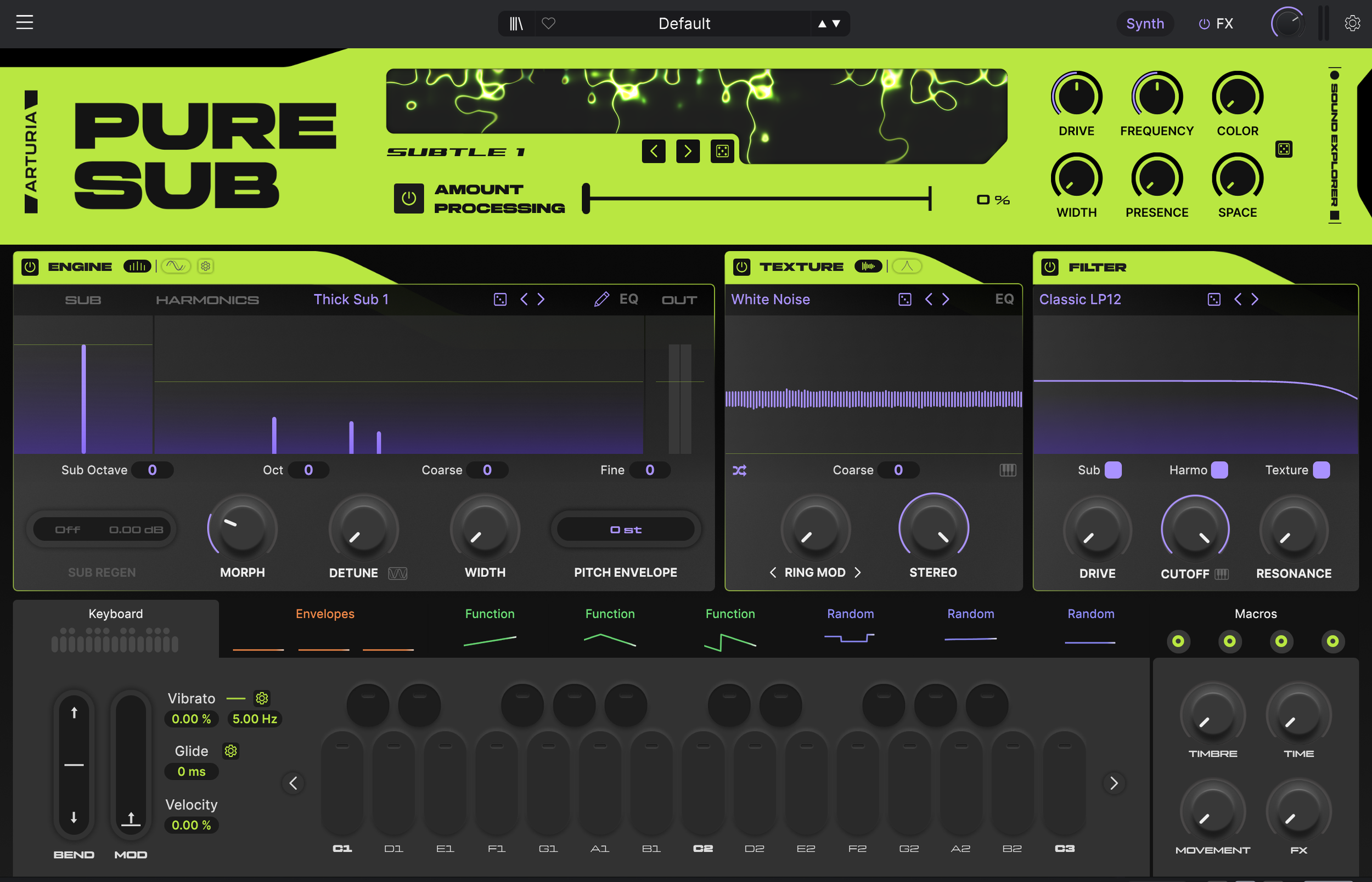
Pure Sub has a single oscillator with a detailed harmonic editor and a Reese mode.
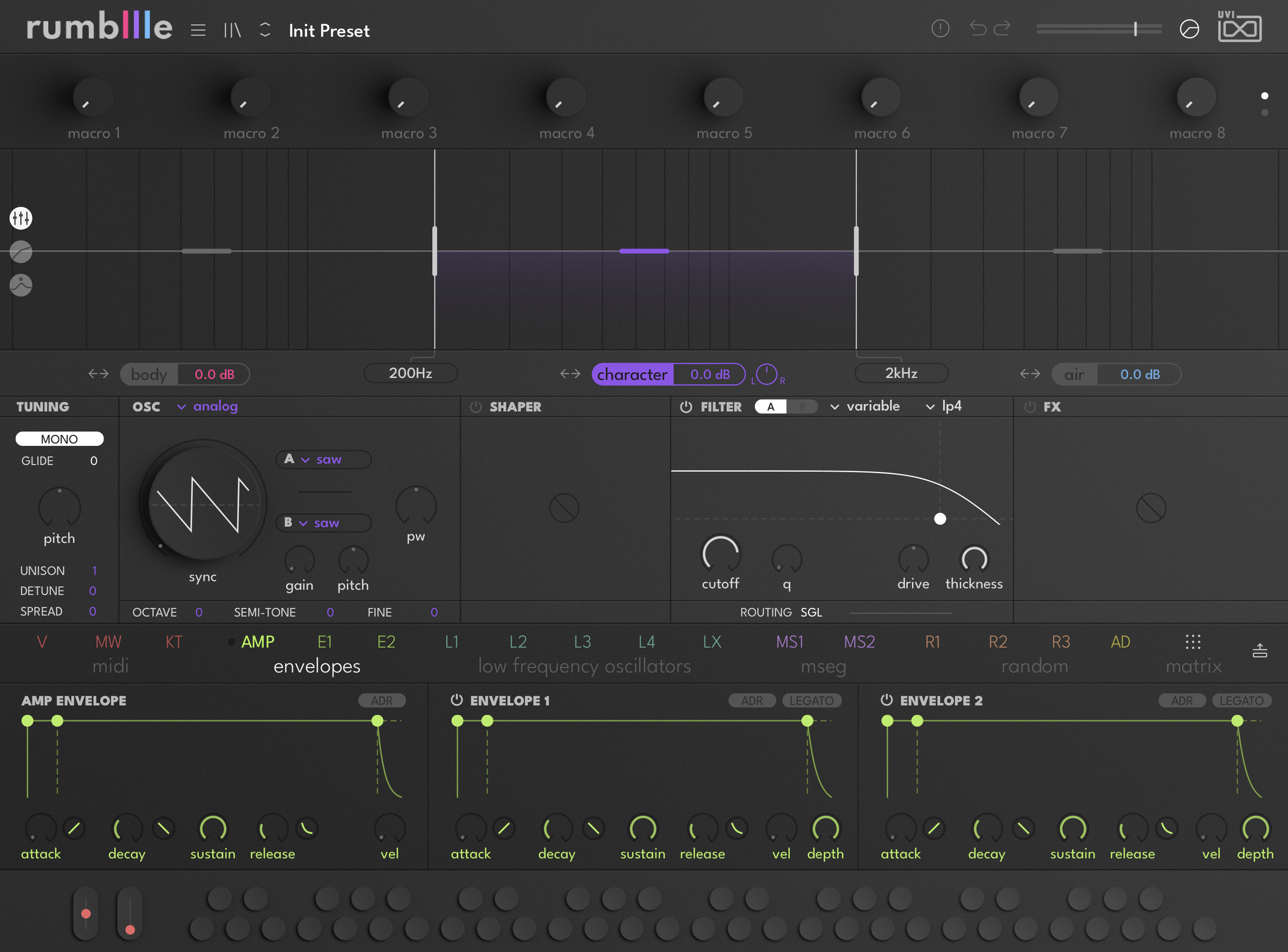
Rumble has three oscillators that are split into three frequency bands offering eight different oscillator modes.
If your goal is strictly sub design, the harmonic editor in Pure Sub offers quite a bit more detailed control, but if you’re looking for a variety of bass tones there’s a bit more to explore with Rumble.
The band splitting is where Rumble really lets you explore bass design, separating out the different oscillator qualities for each frequency range and just offering a lot more oscillator types.
NOISE
Pure Sub has a sample based texture section that can be modulated by the sub oscillator. This glues the noise texture to the synth signal.
Rumble has a ninth oscillator mode for noise which uses two sample layers that are mixed via an XY controller. This requires you to replace an oscillator with noise and doesn’t quite “glue” the noise to the oscillator signal like in Pure Sub. But there’s also a noise distortion mode which modulates the bass signal with noise for a “glued” noise texture.
Both offer a wide variety of noise textures to chose from and tone controls. Notably, each “glued” noise texture works a bit differently with Pure Sub’s noise being modulated by the oscillator, and Rumble’s oscillator being modulated by the noise. Take a listen to the demo to hear the difference.
FILTER
Pure Sub has a single filter with 30+ filter types, lots of cool stuff from Pigments with many filter types offering additional controls.
Rumble has two filters with 24 filter types. Again, cool stuff in here, but less variety compared to Pure Sub
Both filters sound great, you get more layering options in Rumble with the two filters, but Pure Sub also offers filters in the FX section so you actually end up with more serial filtering options in Pure Sub anyways. However, Pure Sub does not offer any way to run parallel filters like you can in Rumble.
MODULATION
Pure Sub:
Envelopes: 3
MSEGs: 3
Random: 3
Macros: 4
Rumble
Envelopes: 3
MSEGs: 2
LFOs: 4
Random: 3
Macros: 8
Both offer fairly similar and robust modulation options, Rumble has a couple nifty little additions like the LFO mix and analog drift modulation, but over all they are very similar when it comes to modulation. I may come back and do a more direct comparison of their MSEGs at some point.
EFFECTS
Pure Sub offers 12 FX slots with 18 different effects to chose from.
Pure Sub also has a “sub processor” with a variety of pre-designed distortion effects.
Rumble has an effect slot per each band with 10 effects to chose from, as well as a pre-filter shaper per band with 10 shaper modes to chose from, totaling in six total FX slots.
Rumble also has a mastering compressor and EQ to round out the signal.
Effects are where these two synths REALLY differ. Pure Sub offers a lot more effects layering in a serial chain, but Rumble has the band splits giving parallel routing. Pure Sub’s effects include multi band compression, EQ, and distortion for loads gain staging control. Rumble has a few more distortion options as well as a cab simulator and a cool “neuro” effect. I’d say Rumble’s effects are a bit more “fun” and integrate into the band split system very well, where Pure Sub offers quite a bit more control and the “sub processor” which is also pretty fun.
On paper it definitely looks like Pure Sub wins out in every category, comparing everything section by section, Pure Sub just offers “more”. But I think this leaves out Rumble’s unique gimmick, which is the three band processing. Having all the effects and engines built into this band split creates a very unique sound design environment the I personally find more enjoyable. Also, if you already own something like Pigments, Pure Sub only expands your sound design palette by just a little where Rumble expands things quite a bit.
I do think Pure Sub offers a lot more control over specifically sub bass sounds. With the harmonic editor and more filters/processing available, you can dial in heavy low frequency signals. Where as with Rumble you can still dial in low end and sub frequencies, but end up with more control over the highs and mids which can be better for driving dirty and distorted basses.
Both are great options, but I think Rumble does a better job at expanding upon existing collections while Pure Sub does a better job at dedicated low frequency design.
If this has helped you decide, please consider using one of my affiliate links to make your purchase, this helps support articles like these:
PURE SUB: https://www.pluginboutique.com/product/1-Instruments/4-Synth/17759-Pure-Sub?a_aid=61c378ab215d5
RUMBLE: https://www.pluginboutique.com/product/1-Instruments/4-Synth/17445-Rumble?a_aid=61c378ab215d5