The Wide Variety Within a Single Instrument Type (Pads)
When creating packs, I have decided to focus on single preset types, I feel this gives the pack a purpose and focus. If you want some cool basses you shouldn’t have to buy pads and plucks as well, and if you’re looking for pads, you should get a wide variety of pads rather than a dozen or so alongside other types of presets. While a large variety grab bag can be a fun way to expand your synths, a collection of dedicated instrument types opens up wide variety with a musical focus.
One thing I’ve found while making these dedicated packs is just how much variety there is within any given instrument type. For the sake of this article let’s define instrument types. These are broad preset categories that fill specific musical roles, for example, pads, keys, leads, bass, percussion. These aren’t necessarily broken down the same way as real instruments, a violin might fit the role of a lead, while a string section could be thought of as a pad.
Now lets look at one of these instrument types. Within pads there are many timbres and textures and tones. You can have simple pads, airy pads, glassy pads, warm lush super saw pads and more, this is just tones. Now when we look at textures a pad can have swooping motion, or sparse ornaments, maybe a rough broken texture, or a jumbled cluster that rattles and jangles. Even just with these two dimensions of a pad; tone and motion, and the few examples I gave for each there are dozens of combinations.
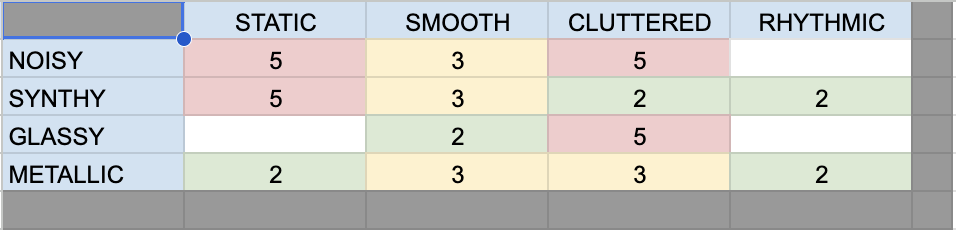
Here was a sound matrix I made while working on my latest pack MYCORRHIZAE. You can see here that the pack isn’t finished, and there’s a few holes in the combination types. At this point I hadn’t made any rhythmic or static glassy pads, not had I made a rhythmic noisy pad.
Making this matrix not only helped me flesh out the sound palette for MYCORRHIZAE, it also provided instant inspiration. Now there were three combinations I could explore while easily avoiding any overlap with the previous presets.
It helps to keep these categories vague and broad. Many watery sounds I made ended up in the “glassy” category, and I’m sure glassy and metallic probably overlap a bit for many people. What is “cluttered”? Stuff that isn’t tightly rhythmic, but has kind of a random jangly “granular” type texture. It’s also worth noting these categories depend on the style of pack as well.
Mixing and matching these different elements keeps things interesting while I focus on specific instrument types. Inversely, if I were to go back to making mixed instrument grab bag type packs, I’d feel like I was missing out on a lot of the potential for these different instrument types. As I go through and make these focussed packs, I come up with many more ideas on how to use these sounds. My focus lately has been on pads and ambient textures, I think these are some of the most immediately useful sounds available in synths.
Pads can be a great way to set the mood for a song, introducing harmonic ideas without directing the melody or structure too much. They can be a way to set the “color scheme” for a piece, setting the stage for everything else that is to come. They also work well for filling space, a pad can be used to bridge two parts of a song, or to simply add some background to a more sparse arrangement. Ambient textures can be a great way to enhance a mood or vibe without adding too obvious of a musical cue. They can fill the sonic role of a pad while keeping the music neutral. And finally, they can be quite relaxing to play, just sitting on a note or chord, letting it ring out slowly while the next one fades in.
I don’t want to just make pads though, I love making basses and leads, as well as plucks, and then of course I love wild sound effects and rhythmic patches. As I build a larger library of different instrument types, I’ll have more to say on each. There are so many sounds each synthesizer is capable of creating and I want to bring useful collections that can add depth and dimension to your music. For those who are more hands on with their synths, they can help guide you through sounds you may not have considered possible and can be used as templates for further exploration.