REFRACTALIZER Review
Datamind Audio have sent me their Refractalizer granular synthesizer. Many people seem to complain about all the new granular synth plugins that keep coming out, but each one still offers something unique to the field, and Refractalizer is no exception. Refractalizer offers a robust grain engine, a sub oscillator, two filters, five envelopes, five LFOs and a simple effects section with eight different effects. The UI is not quite my cup of tea, I apreciate seeing pink/purple in a plugin UI, but I find many of the controls unpleasant to look at. The fonts are a bit tricky to read and many of the details are a bit cluttered.
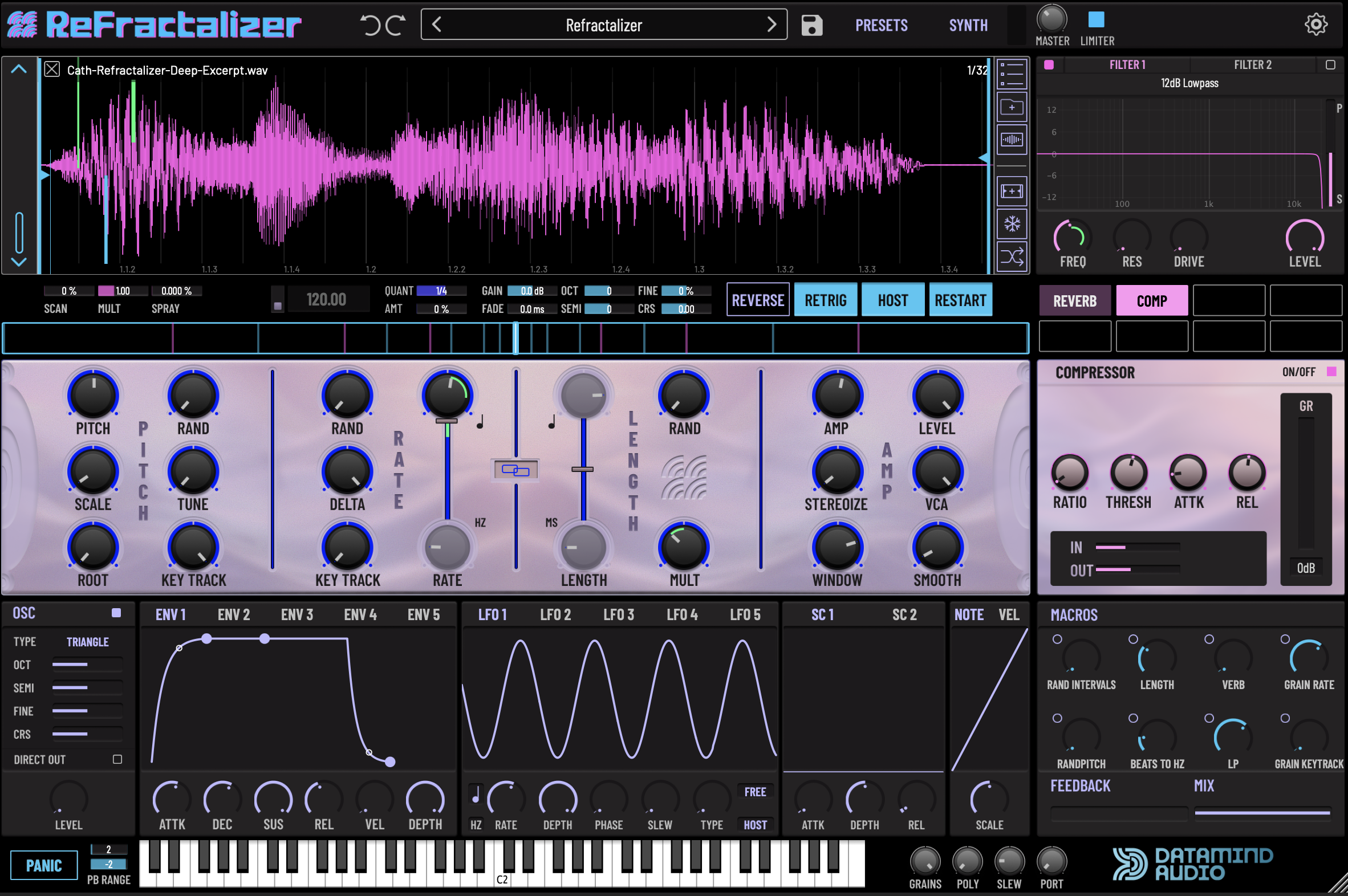
Refractalizer’s grain engine is pretty cool, it seems to have very precise positioning, allowing for smooth motion as you scan a sample. It can also go into incredibly fast audio rate territory, capable of wavetable-like qualities. Allow me to address the coolest feature before I get into more of the details, Refractalizer allows you to load an entire folder or pool of samples into the grain engine, you can then scan between these samples using the provided slider. There’s even a crossfade option that blends between samples as you swap them. This is a pretty awesome feature that opens up a lot of doors and just makes exploring a pool of samples much easier. I do wish there was some sort of spread control that would randomly select between a range of samples per grain.
The grain controls are a little haphazard, with scan rate, spray, pitch, grain rate, and length all being in different places. By default the samples aren’t key-tracked so there’s a bit of setup to get started. You can easily key-track the grain rate which gets into some fun territories fast. The grain controls here are a bit all over the place, prioritizing options over workflow. You can decouple the grain size from rate, and randomize rate, pitch, length, and position. Unfortunately there isn’t a radom spread for the stereo field, instead you get a stereoize effect that swaps left and right grain playback per grain.
Another unique aspect of Refractalizer is how the grain engine handles the sample window. Most granular synths treat the sample as a discrete block, so if the grain window extends beyond the sample region, it just treats that as silence, or prevents the window from moving beyond the sample region. Refractalizer chooses to loop the sample window, so grains that play past the end of the sample continue playing through the beginning. I would prefer this to be a toggle, but it does lead to some interesting effects especially when combined with the pitch randomizer on shorter samples.
The filters and effects are on the more basic side, there’s all the basic filter shapes as well as some cool mulit-peak and multi-notch filters as well as a formant filter. The effects seem to mostly be there to round out the presets. The reverb sounds nice, you also get a delay, distortion, compressor, filter flanger chorus and phasor. I liked the phasor, the chorus sounds too similar to the flanger and the filter is just a copy of the voice filter. You only get access to one of each effect though they can be placed in any order you like.
As for modulation, routing is done via drag and drop which is always appreciated. The LFOs get all the basic shapes and sample hold, but I think a smooth random would be a nice addition. Also I think this synth could really benefit from some MSEGs, having some custom motion across the samples and grain controls would open up a lot more sound design possibilities than the built in effects. There is a cool side-chain modulator, so you can get MSEGs from external sources if you want, but it’s tricky to build that into a preset.
I think the core concept here is really solid, I love the sound of the grain engine at fast rates and just how flexible it is. Also the biggest selling point is the ability to scan through an entire folder. That said, I’d love to see this updated to a version 2 at some point with stronger UI, more interesting filters, MSEGs and perhaps some more polished effects. This one will definitely find its place in my sound design sessions, but I’d really only want to use about 1/4 of the available controls focussing just on the grain engine and LFOs. Actually, something like this engine built into an interface like Polygon would be really cool, allowing for more experimental exploration/ motion with a strong core grain engine.
You can pick up Refractalizer from Datamind’s website here: https://datamindaudio.ai/refractalizer/