
RIPPLER Review
ReFX has released a physical modeling synthesizer, Rippler. You may be familiar with their free version, Rippler X. Rippler expands on this free version with four resonators, two layers, a variety of modulation, a multi effects section and more. The UI is a nice pleasing soft and dark neuomorphic design that has a mostly vector style vibe with a touch of skeuomorphism on the knobs and sliders. I really like the colors here and everything feels nice. I could do without the drag and drop icons, I understand their purpose, but I find these tend to clutter an otherwise minimalistic layout.
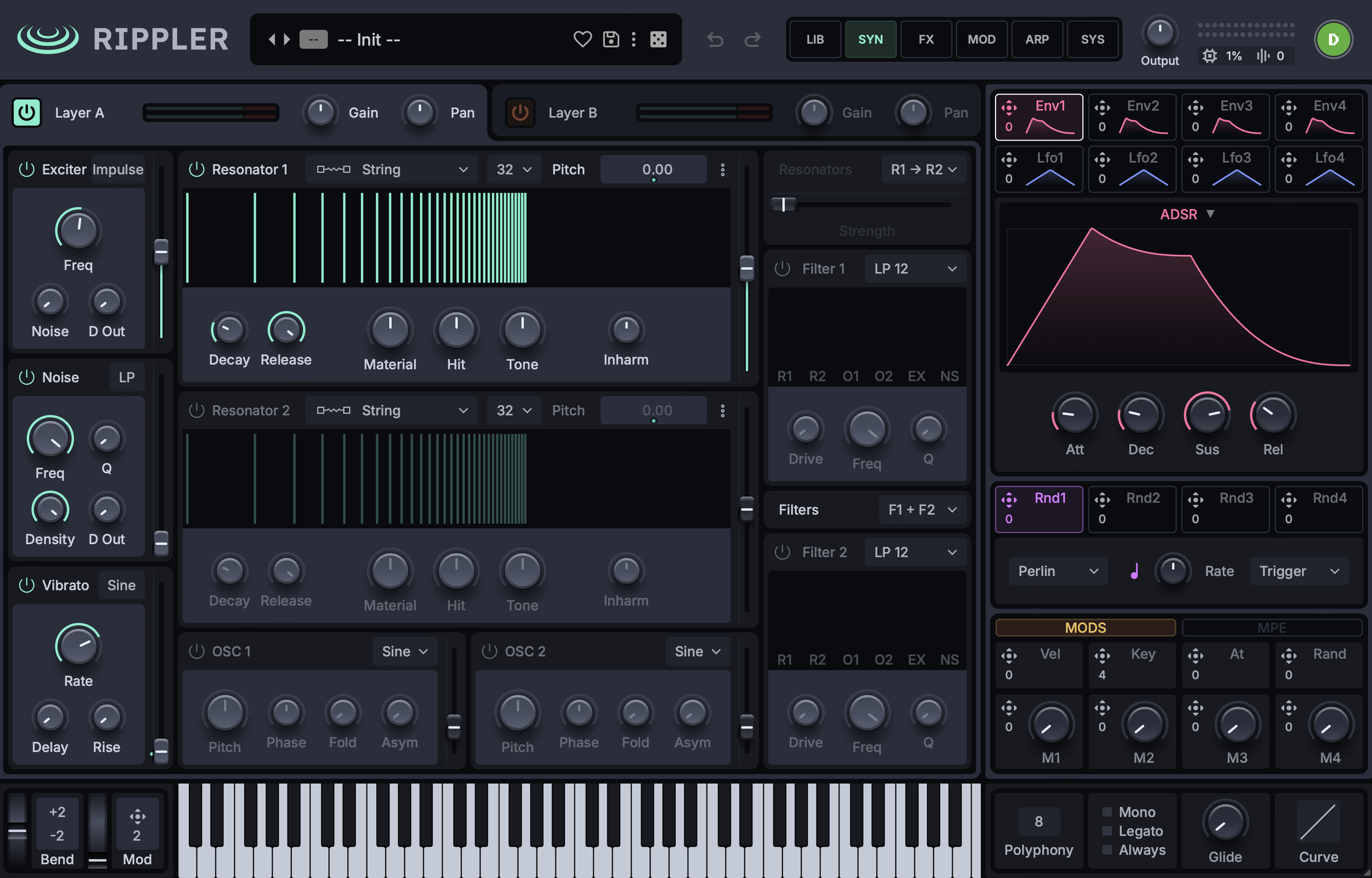
OSCILLATORS
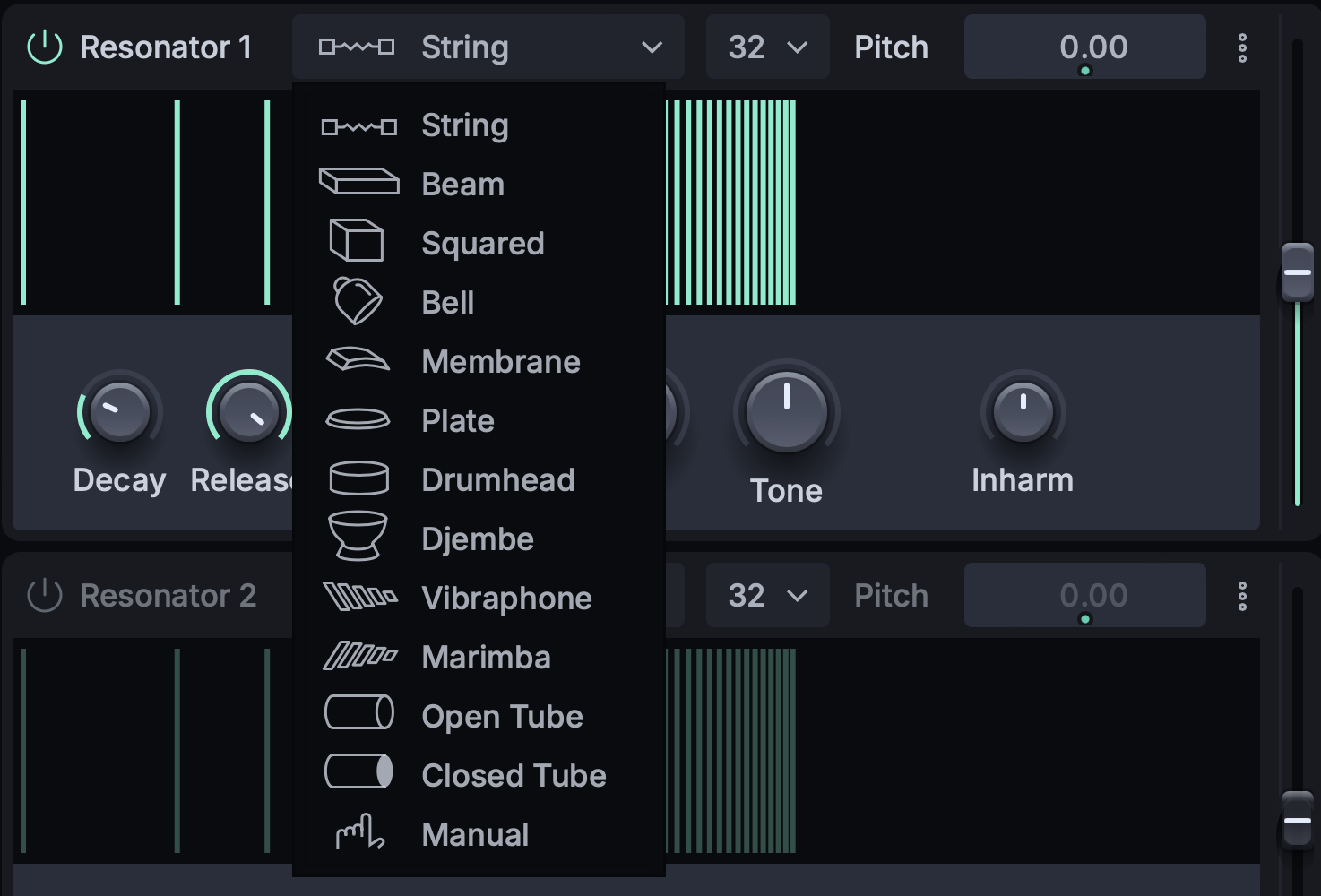
At the core of Rippler is four resonator oscillators that can be excited with noise or a variety of exciter samples. Each resonator can be set to one of thirteen different models: string, beam, squared, bell, membrane, plate drumhead, djembe, vibraphone, marimba, open tube, closed tube, and manual. Each resonator can have up to 64 partials, but the default 32 is usually more than enough. Each model tunes these partials differently to mimic their respective material. Some models have an additional “ratio” control which seems to handle differently depending on the material
The inharmonic and ratio controls change the tunings of various partials allowing for a wide variety of resonant spectrums. These controls really let you shape the core sound of Rippler while everything else lets you dial in the details. The resonators respond really well to various impulse tones and have three main tone shaping controls. Material dampens the decay of high or low partials to create a natural fall off. Tone lowers the volume closer to a tilt filter, while “hit” seems to reduce the volume of various partials and seems to mimic an all-pass filter.
The four resonators are split into two layers. Within each layer, the pair of resonators can either run parallel or in series with one resonator feeding into the next. Resonators in series can be a bit tricky to tame, as partials can sum together and overwhelm the signal, or just not even line up and go silent. Rippler seems to handle this pretty well, though it can still be a bit tricky to dial in. They’ve included a “strength” control which helps a lot, and there’s always a limiter effect on by default to help tame the signal.
Rippler also has two oscillators that run parallel to the resonators, these are great for adding a controlled sine to the signal to flesh out its fundamental if your resonator model isn’t covering that duty well enough. I do wish we could run the oscillators into the resonators, this would be particularly fun with the saw wave.
FILTERS AND FX
Each layer gets two filters which can be run in parallel or series. Each filter can receive signal from any resonator, oscillator or exciter from its current layer.
There’s a variety of filter shapes, mostly standard curves and modeled filters, but there are a few comb filters if you wanted even more resonators to play with.
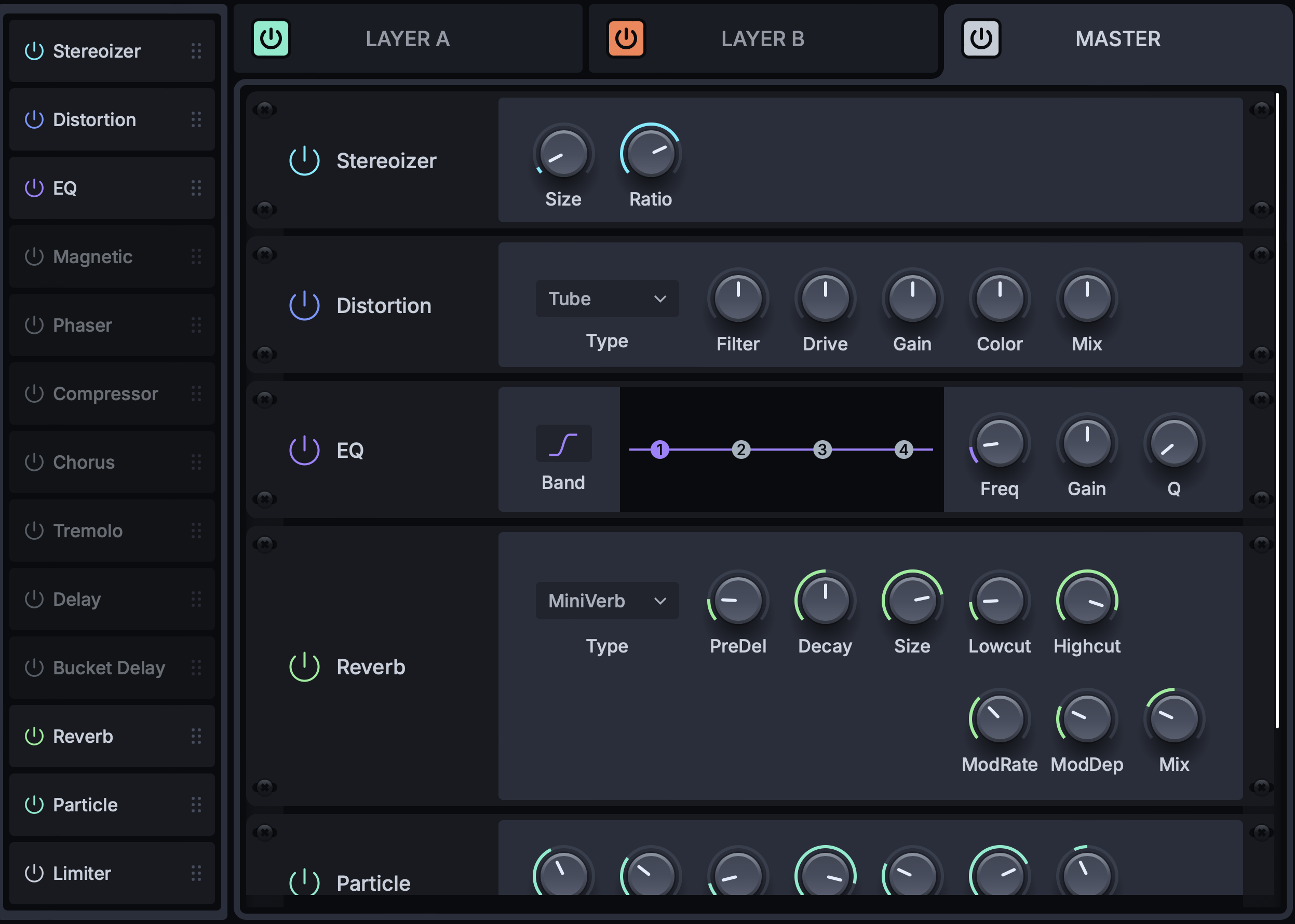
The FX tab gives you a rack of 13 effects to chose from. Each layer and the master channel have their own effects rack so you can really customize the processing. These aren’t my favorite effects included with any synthesizer, they do the job and a couple are noteworthy, but most are your usual basic built in synth effects. The distortion only has 3 modes which all sound fairly similar. There is a bucket brigade delay and a magnetic tape effect which provide some vintage tones.
The reverb is very nice, it reminds me of Raum and Valhalla. I has that nice soft smeared decay with very few reflection artifacts that some lower quality reverbs can have. It also includes a shimmer effect which is a lovely addition. Also worth noting is the particle granular effect. I was excited to see this included, but it’s a pretty stripped down grain effect that works better for adding a touch of background texture. It’s an interesting choice to include as the shimmer does this so well already, but it’s still cool to see.
MODULATION
The modulation is simple, drag and drop style modulation with a mod matrix. You get four of everything, four envelopes, four LFOs, four randomizers, four macros, then all your key/MPE stuff as well. There’s a few different envelope modes: ADSR, AHD, DADSR, and DAHDSR. The randomizers offer Perlin noise and SH modes. The LFOs are MSEG style LFOs that allow you to draw shapes via vector nodes. I will say, the LFOs have one of my biggest pet peeves, which is that you can drag nodes past one another, making it incredibly difficult to create patterns. I’m sure some people prefer this though.
The main star of the show with Rippler is the resonators. These are incredibly flexible and I didn’t even touch on the manual mode which lets you create custom resonator partials. The custom mode is a bit tricky to use, I think it could benefit from a full screen editor. Regardless, the various included materials, exciters, and routing allow you to create a lot of very musical physically modeled sounds. While I normally cover some of the weirder physical modeling synths, this one definitely captures a more “musical” instrument feel. Add to this the separate FX layers and you have a tool that can create some amazingly rounded out mix ready instruments. Oh and there’s also an arp. Over all, Rippler is a fun synth that I kinda wish I had years ago.