PAM Review
Map Audio sent me a copy of their PAM drum machine for review. PAM had been on my radar for some time, but I always assumed it was just a sample based drum machine, to my surprise it actually has quite a few drum engines built in. While I dig samplers, and sequencers, and drum synths, there’s just something special when you put it all together, especially sequencing and synthesis. As much as I love samples, built in drum engines give me a lot more room to explore without having to prepare new sounds in advanced.
The over all UI is quite a lot to take in, there are lots of panels everywhere, some items are tabbed, others can have floating windows, and some tabs can be split into multiple channel views. I have to say it’s not the most user friendly at first, but it does look lovely. I really enjoy the colors, the mostly flat minimalistic design with a touch of color here and there. It’s an inspiring layout and the sheer quantity of options makes you want to dive in deeper.
I think my one real complaint is that the randomizer buttons are sized, positioned and styled almost identically to the navigation buttons. It’s easy enough to figure out, but it’s a design choice that can catch you off guard.
DRUM ENGINES
PAM comes with 22 drum engines in addition to it’s built in sampler. I spent my time focused on the drum engines for this review, but will come back to share my thoughts on the sampler later. The 22 drum engines include mostly analog style drums similar to what you’d find on an 808, but there’s also some “acoustic” models, FM and wavetable, and even a pluck.
Each engine is fairly simple, offering only a couple tone controls. For the most part they sound solid, I really liked the snares. The real magic here comes from the extensive processing available in the FX section which I’ll cover later.
All of the engine parameters can be sequenced or modulated via LFO or envelope. And there’s even an arp for creating some fun effects.
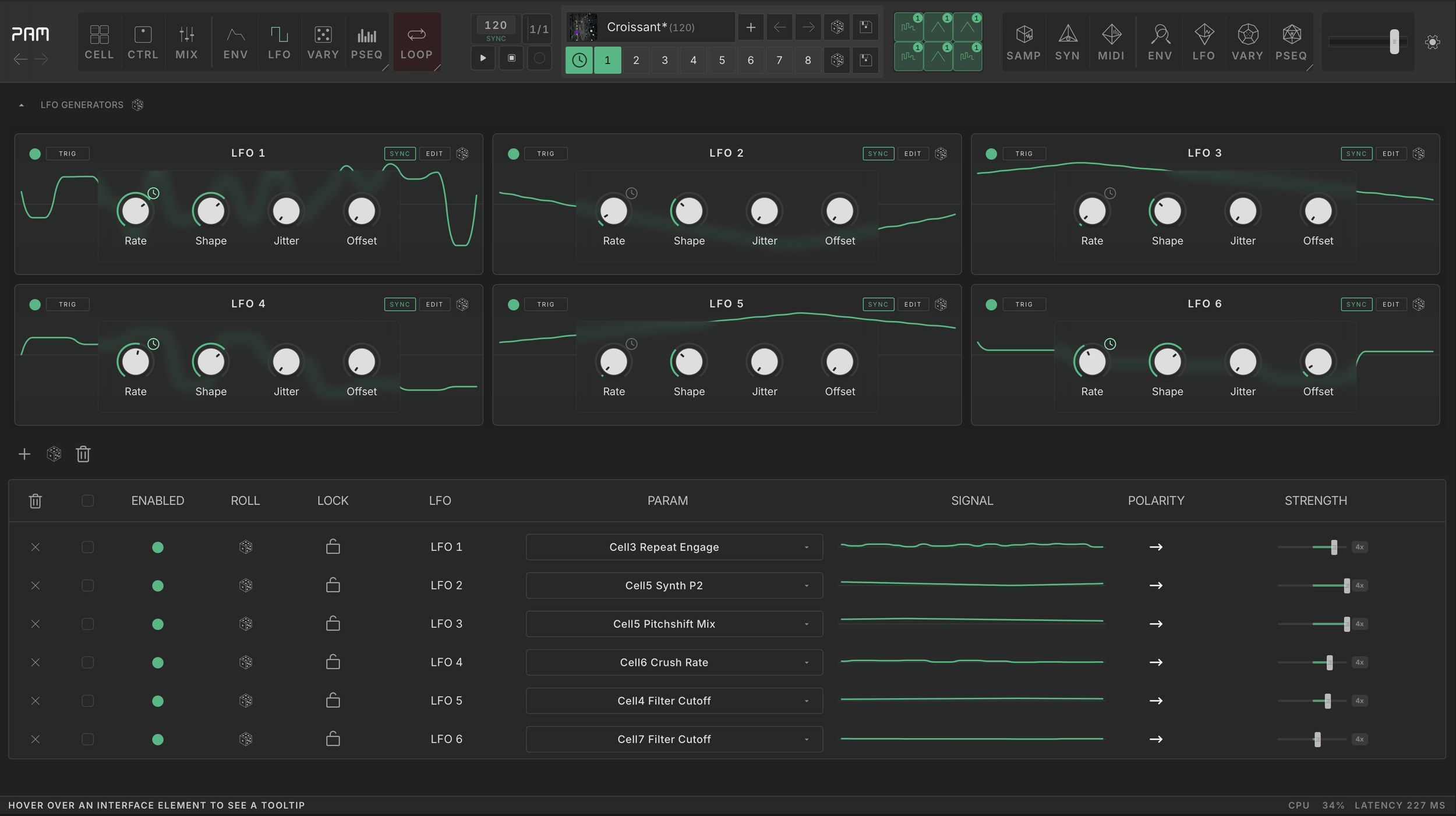
There’s six LFOs for modulation across all of PAM. These can be set to any basic wave shape, random, or a custom wave shape. There’s also an envelope system that I didn’t really spend much time with, it seems to have a modular aspect to it, which feels odd to see patch cables for one type of modulation but not the other. I also noticed a “variation” modulation mode, but haven’t spent enough time with it to figure it out. Again, this plugin is VERY deep, between drum engines, sampler, sequencer, modulation, and effects, there’s a LOT to cover. PAM is being updated regularly, so I’ll revisit this review over time.
SEQUENCER
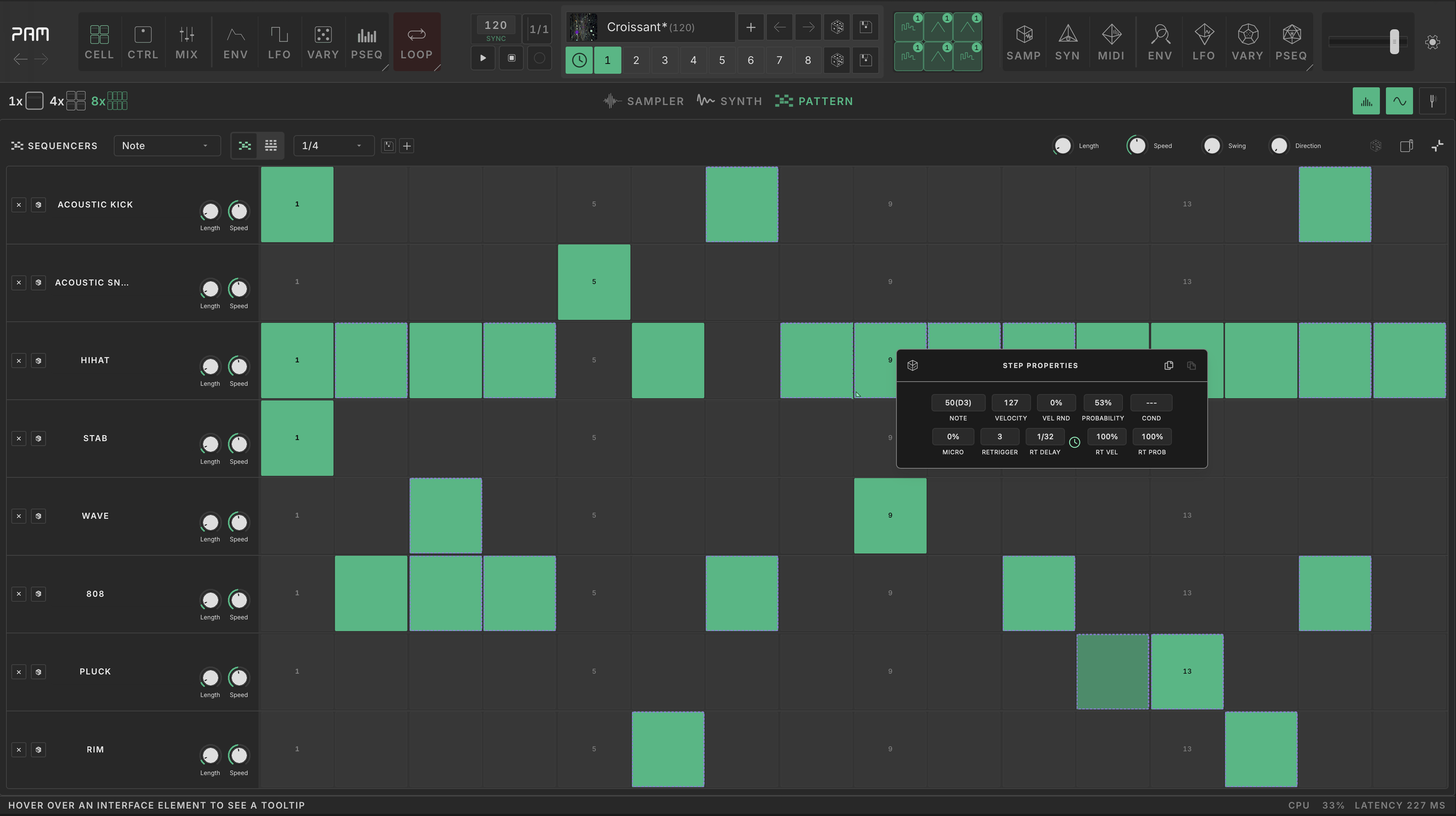
PAM’s sequencer is pretty deep, each drum voice gets its own step sequencer which can go up to 8 measures in length. With a resolution of 32 steps per beat, this has the potential to get unusably dense. Luckily each step has its own trig conditions (Available via cmd+click) so you can achieve loads of variety without needing super long sequences.
The step properties are really cool, you can assign random velocity, trig probability and conditions, micro timing, retriggering, and even retrigger probability. Combining complex trig conditions allows for a very minimal pattern to evolve in interesting ways.
The sequencer also automatically copies its self when expanding, so you can focus on just adding or subtracting elements from the extension rather than having to redo everything.
I really enjoyed the random ping-pong loop mode, which occasionally reverses the playback of the sequencer. This allows for some very interesting fugue design.
EFFECTS
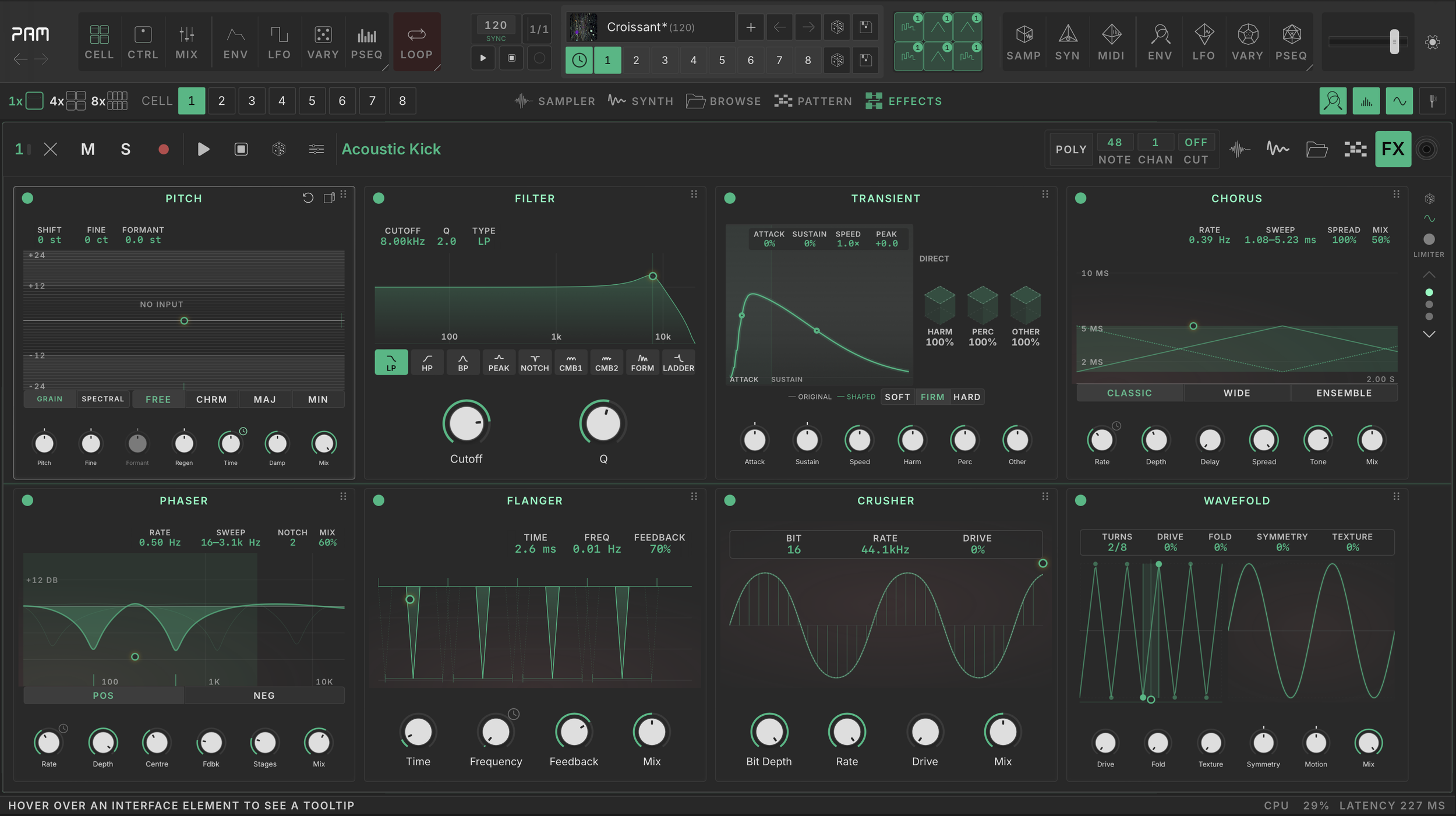
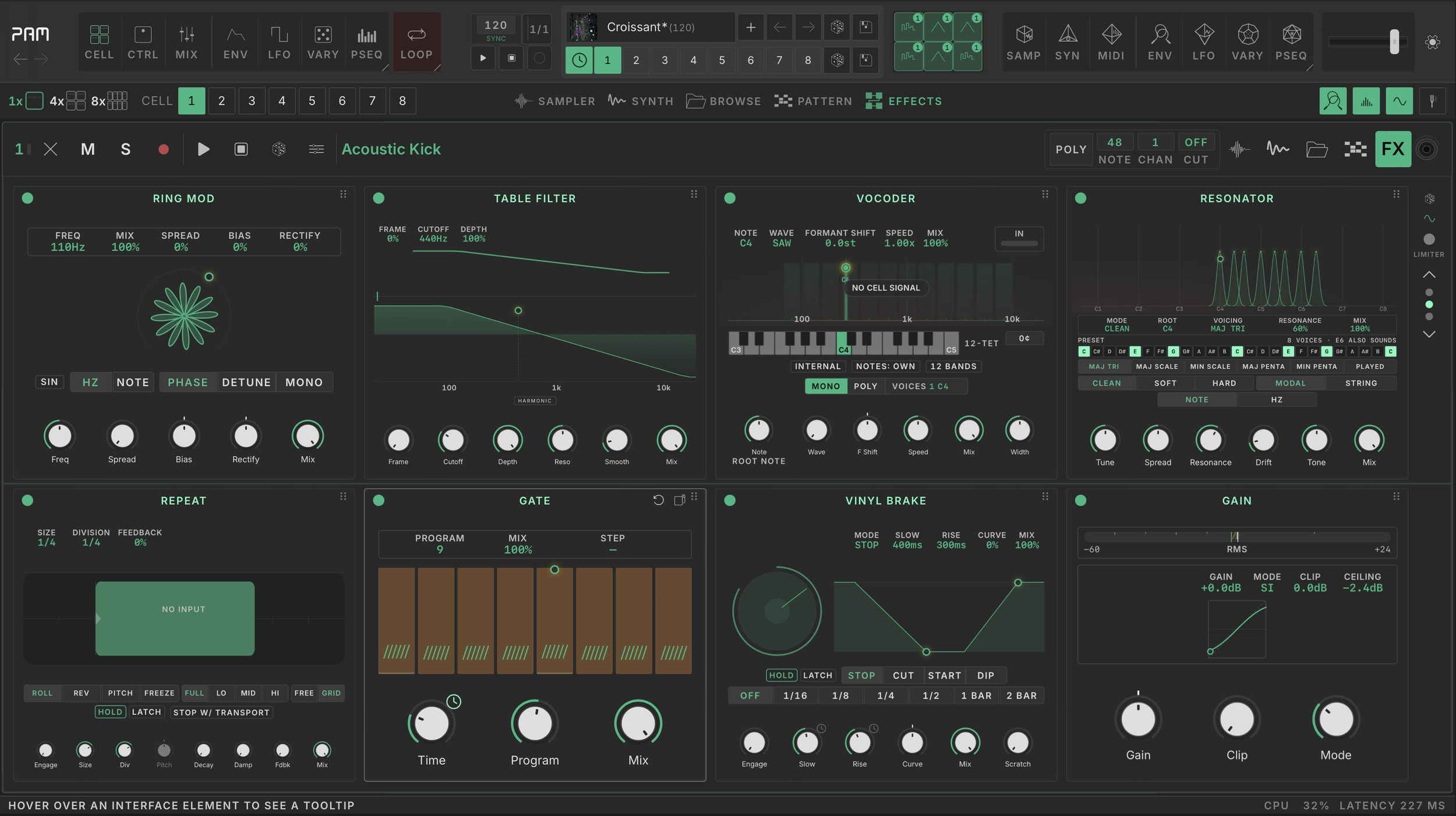
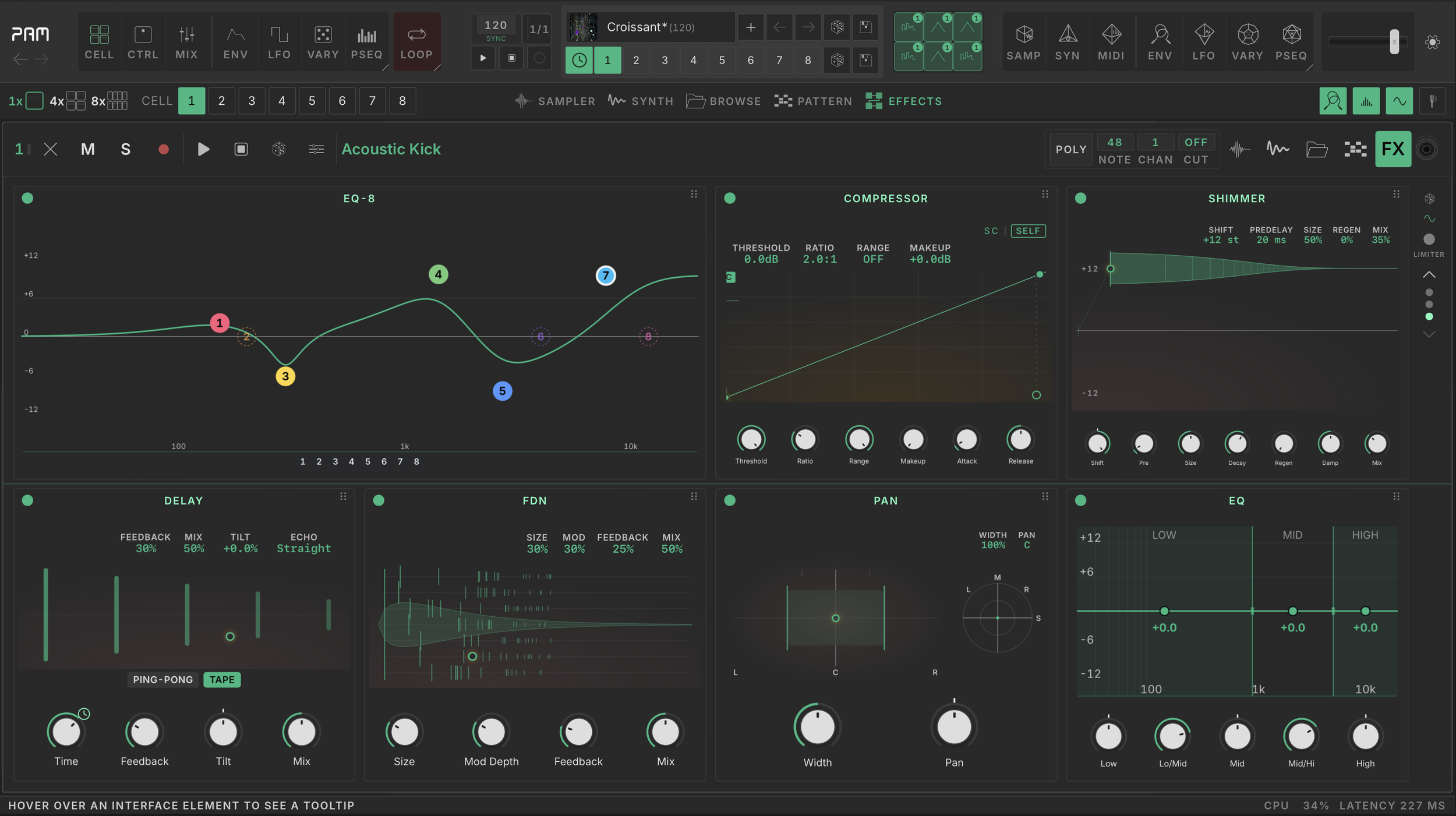
The effects in PAM are really cool, each drum part gets its own chain of effects with 24 different effects. You only get one instance of each effect, but you can place them in whichever order you like. There’s lots of solid mixing tools here; compressor, EQs, limiter, utilities. As well there’s lots of classic effects like delay, chorus, phaser, filter, as well as a crusher and wavefolder for distortion. On top of all that there’s also some really fun advanced effects like a pattern gate, repeater, table filter, and ever a vocoder.
It can be a lot to navigate, but the plethora of effects really allow you to sculpt each drum part and create nearly mix-ready sequences. Add to this that all of the parameters can be modulated or sequenced as well.
In addition to these per-part effects, there’s an additional eight effects on the master channel. These focus more on adding a final polish rather than anything too experimental.
I found the density of effects available really let me work on patterns in a way that I actually prefer. For the most part, you don’t need a particularly amazing drum sound if you throw enough processing at it. Not everyone will agree on this workflow, but personally I find the results to be more polished and interesting
I took a look into the experimental settings, and MAP offers a plugin host, meaning you can load something like Kick 3 as a drum voice, which is pretty cool. I also noticed there was a sort of “resampling” feature in the sampler engine, I’ll be very curious to try this out, perhaps PAM can function as a sort of glitch processor? As mentioned earlier, PAM is being updated on a regular basis. Since installing, I seem to be notified of an update daily. In my personal opinion, this fast of an update cycle is too fast, I personally prefer things to be tested quite a bit more, and worked into a cohesive system, but I also think this approach might work for PAM, which already has quite a few systems layered into one another. I think PAM is a very interesting drum machine with a LOT to offer. While I may not particularly enjoy every aspect of its workflow, I definitely found myself making music in a way I enjoy without ever feeling too limited by the sound palette.